

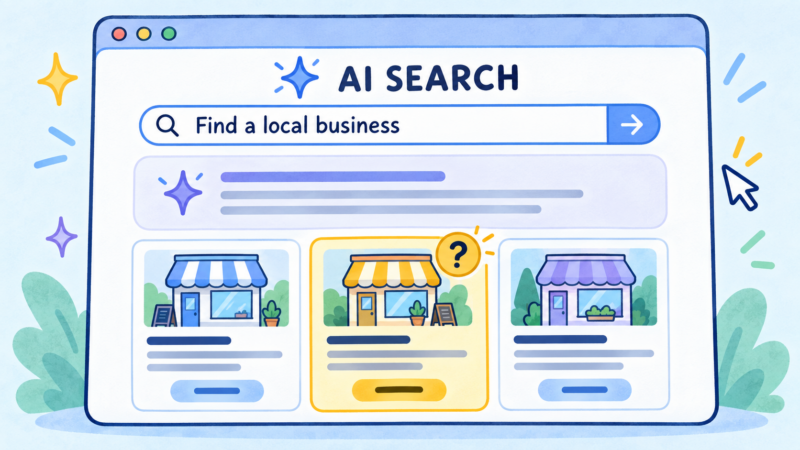
The pitch is popping up wherever businesses buy marketing services: Get noticed by ChatGPT. Become the business AI recommends. Reach the top of AI search before your competitors do.
The advertisements tap into an understandable concern. As search tools increasingly present generated answers alongside—or in place of—lists of links, business owners face a new question: Will their companies be included in those answers?
There is a legitimate service behind some of these offers. Businesses can improve the information that search systems use to find and describe them. But the distance between helping a company become more discoverable and guaranteeing that an AI tool will recommend it is considerable. Advertising can blur that distinction.
The emerging practice goes by several names, including AI SEO, answer engine optimization, and generative engine optimization. The terminology suggests a departure from traditional search engine optimization, but Google describes substantial continuity. Its guidance says established SEO practices remain relevant because its generative search features rely on core search ranking and quality systems. Google Search Central
That makes much of the work familiar: publishing useful information, explaining services clearly, keeping business details accurate, and ensuring that a website can be accessed by search systems. A business whose website barely describes its services gives those systems little information to work with. A company with detailed, current information provides a stronger basis for an accurate answer, although that alone does not guarantee inclusion.
There are also platform-specific technical considerations. OpenAI advises website publishers to allow its search crawler, OAI-SearchBot, to access their content so it can be discovered and included in ChatGPT search summaries and snippets. Checking whether a website blocks that access is a concrete service a provider can perform. It is a step toward eligibility, however, rather than a purchase of preferential treatment. OpenAI’s publisher FAQ
The meaning of “visibility” deserves equally close attention. An AI system might mention a company, cite an article from its website, or recommend its services. These outcomes are related, but they are not interchangeable. A business cited as the source of an explanation has not necessarily been endorsed as the best provider to hire.
This distinction matters when evaluating promotional claims. A screenshot showing a company in an AI answer documents that particular result. It does not, by itself, establish how frequently the company appears, which prospective customers see it, or whether the exposure produces business. A claim about reaching “the top” is difficult to assess without knowing the platform, question, location, and period being measured.
Some sales pitches emphasize special files or formatting said to make websites attractive to AI. Here, the details matter more than the label. Google explicitly says it does not require special AI text files or markup for its generative search features. It also says that the much-discussed llms.txt file neither helps nor harms visibility in Google Search because Google ignores it. That guidance is specific to Google, but it challenges the suggestion that every business needs a new technical ingredient to participate in AI search. Google Search Central
Promises of guaranteed placement warrant particular skepticism. Google states that even meeting its requirements and following its best practices does not guarantee that a page will be crawled, indexed, or displayed. A marketing provider can control the changes it makes to a client’s website. It cannot make an equivalent commitment on behalf of the search platform selecting the sources. Google Search Central
Measurement is developing alongside these services. Microsoft has introduced AI performance reporting in Bing Webmaster Tools, allowing website owners to see how their content is cited in supported AI experiences. Such reporting offers more useful evidence than an isolated demonstration, although citation counts still measure exposure rather than customer acquisition. Bing Webmaster Blog
For a business, the commercial question remains whether that exposure leads to relevant visits, inquiries, appointments, or sales. An increase in mentions may be encouraging, but it should not automatically be presented as an increase in revenue. Credible reporting explains both what changed and what the available evidence can establish.
For companies offering website and marketing services, AI search creates a reasonable extension of existing work. Reviewing discoverability, improving business information, and monitoring results are tangible services. Their value depends on the quality of the work and its usefulness to the client, not on whether the proposal carries the newest acronym.
AI SEO, then, is neither an invented service nor a dependable shortcut to the first recommendation. It combines established search practices with the requirements and measurement challenges of newer search tools. The credible promise is to improve a business’s chances of being found and accurately understood. A guaranteed place at the top is a different claim—and one an advertisement alone cannot substantiate.