

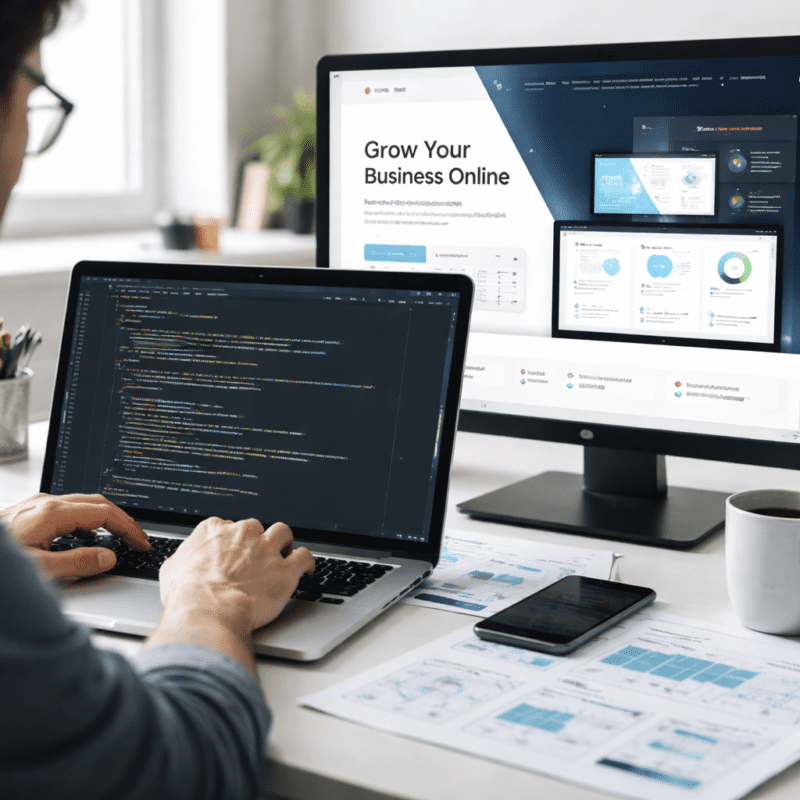
Templates are useful. They are fast to deploy, relatively affordable, and for many businesses they serve as a practical starting point. For companies establishing their first professional online presence, a well-built template can provide structure and visual polish without significant upfront investment. However, there comes a point when what once felt efficient begins to feel restrictive. That is the moment when custom development becomes transformative.
Most pre-built themes are designed to serve the average business. To accomplish that, they rely on generic layout structures and bloated codebases capable of supporting countless potential use cases. While that flexibility appears convenient, it often introduces unnecessary complexity. As your business grows and your processes become more refined, you may find yourself adapting your workflow to fit the theme rather than the theme adapting to fit your workflow. When you start thinking, “I wish it could just do this one thing,” or questioning why your website cannot connect seamlessly to internal systems, you are likely encountering the limits of a template-based structure.
Custom development shifts the focus from aesthetics to functionality. It is not about adding flashy features; it is about solving real operational challenges. Businesses often benefit from custom WordPress plugins designed around their exact processes, proprietary tools that competitors do not have access to, tailored client dashboards, specialized booking or ordering systems, and API integrations that allow platforms to communicate efficiently. When your website reflects the way your business truly operates, friction decreases. Productivity improves. Over time, that operational efficiency directly influences profitability.
Performance gains are another significant advantage. Pre-built themes frequently require multiple plugins to accomplish a single objective, each adding scripts, increasing load times, and introducing potential conflicts. Custom-built solutions eliminate unnecessary bloat by consolidating functionality into streamlined code. The result is reduced script load, improved speed, fewer compatibility issues, and stronger security. A cleaner foundation produces measurable performance improvements.
There is also a competitive dimension to consider. When businesses within the same industry rely on identical themes and plugin combinations, their digital presence begins to feel interchangeable. Custom development introduces unique functionality and strategic differentiation. It allows systems to be tailored precisely to your brand and service model. This is not about vanity or complexity for its own sake. It is about positioning your company as distinct in both experience and capability.
The right time to consider custom development often reveals itself gradually. Repetitive manual tasks that could be automated, disconnected systems that fail to communicate, business models that stretch beyond the limitations of a theme, or growth slowed by software constraints are all signals. Templates remain valuable tools, but tools have limits. Infrastructure is built for longevity and scale.
If your website plays a central role in revenue generation, client acquisition, or operational efficiency, it may deserve more than a one-size-fits-all solution. Custom development transforms a website from a convenient platform into a strategic asset designed specifically for your business trajectory.