

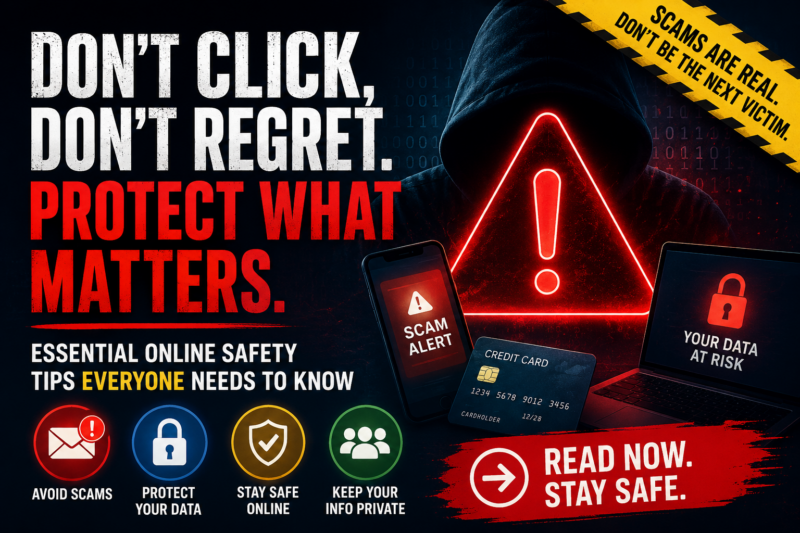
A Practical Guide to Staying Safe in a World Full of Online Scams
It feels like every week brings a new warning. A phishing email pretending to be your bank. A text message claiming suspicious activity on your account. A social media message from someone you haven’t spoken to in years. A phone call about a package you never ordered.
Scams are no longer rare incidents. They are constant, automated, and increasingly sophisticated. The troubling part is not just that scams exist — it’s how convincing they’ve become.
Cyber-criminals no longer rely on obvious spelling errors and suspicious links. They mirror legitimate branding. They replicate email signatures. They spoof phone numbers. They research their targets. And they rely on one thing above all else: urgency.
The most important rule of online safety is simple. Slow down.
Most successful scams exploit emotion. Fear. Excitement. Curiosity. Pressure. If a message tells you your account will be closed immediately, your payment failed, your tax refund is waiting, or a family member is in danger, that emotional spike is intentional. Urgency is the tool.
Never click directly from a message that demands immediate action. Instead, open a new browser window and manually type the official website address yourself. If it’s your bank, go to your bank’s actual website. If it’s Amazon, log in through Amazon.com. If there’s a real issue, it will appear in your account dashboard.
Email safety starts with examining the sender’s address, not just the display name. Scammers often create addresses that look almost correct but contain subtle differences. Hover over links before clicking to see where they truly lead. If the URL looks unfamiliar, shortened, or slightly altered, do not proceed.
Text message scams are rising quickly. Delivery notifications, fake account alerts, and prize offers are common traps. Legitimate companies rarely request sensitive information through text. If you receive a suspicious message, delete it. Do not reply. Even responding with “STOP” can confirm your number is active.
Password hygiene remains one of the strongest defenses. Reusing the same password across multiple platforms is risky. If one account is compromised, attackers test those credentials elsewhere. Use unique passwords for critical accounts and enable two-factor authentication whenever possible. That second verification step can prevent unauthorized access even if a password is exposed.
Public Wi-Fi networks present additional risk. Avoid accessing financial accounts or sensitive systems on unsecured networks. If you must use public Wi-Fi, refrain from logging into important accounts until you are on a secure connection.
Social media also requires vigilance. Scammers impersonate friends, create fake business pages, and send direct messages with malicious links. Be cautious of sudden investment opportunities, emergency money requests, or unfamiliar attachments. When in doubt, verify through a separate communication method.
Business owners face additional threats. Fake invoices, fraudulent wire requests, and phishing emails targeting employee credentials are increasingly common. Establish internal policies that require verbal confirmation before transferring funds or updating payment information. One quick phone call can prevent devastating losses.
Data protection extends beyond clicking links. Keep devices updated. Install system updates promptly. Those updates often contain critical security patches. Back up important files regularly so ransomware attacks cannot hold your data hostage.
Online safety is not about paranoia. It is about awareness. The internet remains one of the most powerful tools for communication, commerce, and growth. But like any powerful tool, it requires responsible handling.
The reality is this: scammers rely on distraction and speed. They win when people react quickly. They lose when people pause.
Slow down. Verify independently. Protect your credentials. Update your systems. And teach your employees and family members to do the same.
Staying safe online does not require advanced technical skills. It requires attention, skepticism, and disciplined habits.
In a world full of digital noise, awareness is your strongest firewall.